The intensive collaboration between diederendirrix, the construction team, and the client on the museum extension of the Van Gogh Village in Nuenen has been highly successful, according to director Simone van der Heiden. “The perfectly executed details, the earthy colours, the careful choice of materials, and the layering—everything together breathes Vincent van Gogh. I feel it’s a joy to go to work every day,” she says. Employees, volunteers, and visitors feel the same way.
The Van Gogh Village Museum, housed in the monumental former town hall in Nuenen, had become too small and was in need of renewal. “You can’t simply relocate this museum,” says Simone van der Heiden, director of Van Gogh Village Nuenen, “because Vincent van Gogh is inseparably connected to the village and its surroundings. There is no place in the world where so much of and about the painter can be seen in and around one location. Nuenen is one large open-air museum.” That is why it was a once-in-a-lifetime, unique opportunity: next to the museum, a small vacant plot—where two long-gabled farmhouses once stood—could be used for the museum extension. On this site, diederendirrix realized an iconic monument of our time, directly opposite the parsonage where Van Gogh lived with his parents.
“In the selection process involving three architectural firms, we unanimously chose diederendirrix,” Van der Heiden explains. “The architects have extensive experience with monumental heritage and with creating meaningful experiences in special buildings, as they previously demonstrated with Domus Dela in Eindhoven. Above all, they had thoroughly immersed themselves in Van Gogh’s Nuenen period and translated it in a layered way down to the smallest details. That is impressive,” she says. “This is reflected in the use of earthy colours, local materials such as poplar wood—the tree Van Gogh also painted here—and the special ceramic roof tiles on the façade, whose hues refer to the colours Van Gogh used. The walls are finished with a special artisanal plastering technique, giving them the feel of coarse brushstrokes, and the concrete floors deliberately show cracks in various places, referring to the rammed-earth floors of the past that cracked as they dried.”
Window as a Van Gogh Painting
Another striking detail is the enormous window overlooking Van Gogh’s former home across the street, where the thirty-year-old painter spent two years from 1883 onward, inspired by village life and the farmers, weavers, and labourers, creating a quarter of his oeuvre, including the masterpiece The Potato Eaters. The window functions as a modern painting. “In this way, constant connections arise between past and present. Everything feels like Vincent, and you still experience that the moment you enter the museum,” says the director.
Van der Heiden is also enthusiastic about the design, through which diederendirrix creates a connection with the surroundings. The old barn doors of the long-gabled farmhouses return in a contemporary version in the entrance, which opens the building to the village with an elegant arch. Glass and sightlines create a relationship with the surroundings and passers-by, giving the building an inviting character, imbued with Brabant hospitality.
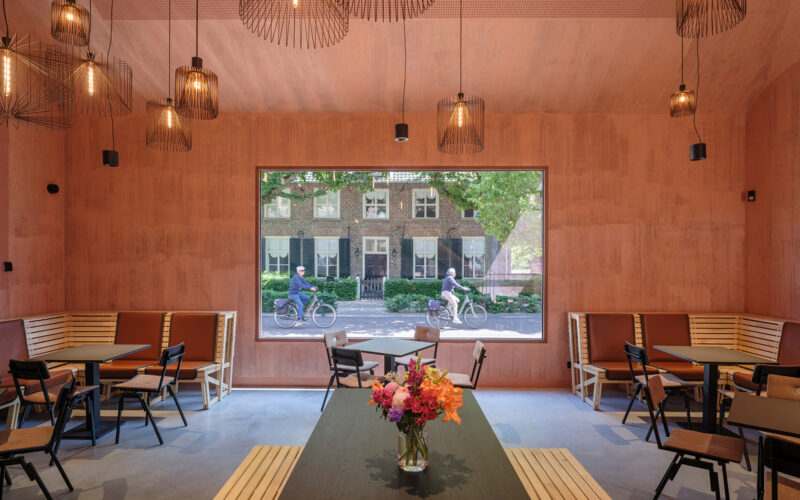
The window overlooking the former residence
Photo: Ossip van Duivenbode
A Continuous Challenge
Everything was achieved thanks to the power of collaboration, the museum director believes. “We challenged one another in a positive and constructive way to create the best and most beautiful result within the budget. We were open and encouraged each other to go that extra step.” This also applied to the collaboration with the client, the Van Gogh Sites Foundation, and the construction team of Banbouw. “Together, we were constantly searching for materials and solutions, such as suitable and affordable ceramic roof tiles for the façade. We also explored how small details can help realize a new building that shows respect for the monumental structure—not by dominating it, but by strengthening one another. Everyone wanted everything to be perfectly finished down to the very last detail.”
A Key Role for Sharing Knowledge
Optimal use was made of each other’s expertise: the museum team understands how visitors behave and move through the space, diederendirrix is an expert in detailing, and the project manager and site supervisor played a key role in finding practical solutions. “We are all proud that it succeeded one hundred percent,” says the director. “The way we operated as a team played an important role in winning the Public Prize of the BNA Best Building of the Year 2024.”
“Every day it feels like a celebration to enter the museum, whether you are the director, an employee, a volunteer, or a visitor,” Van der Heiden believes. “The strong collaboration has brought extra attention, experience, openness, and atmosphere; you feel it throughout the entire building.” The telling figures underline that success: the opening of the new building in 2023 resulted in a jump from 18,000 to 50,000 visitors per year, and the growth continues.
Written by: Viveka van de Vliet