The former Philips office campus Vredeoord has largely been transformed into the residential neighbourhood Vredeoord in recent years. The redevelopment around the former monumental VB office building (Vredeoord Building B) forms the final phase in the creation of the district. Diederendirrix designed an urban plan in which the integration of the repurposed high-rise office building and a densification task along the Boschdijk are central. The landscape design was created by Buro Lubbers.
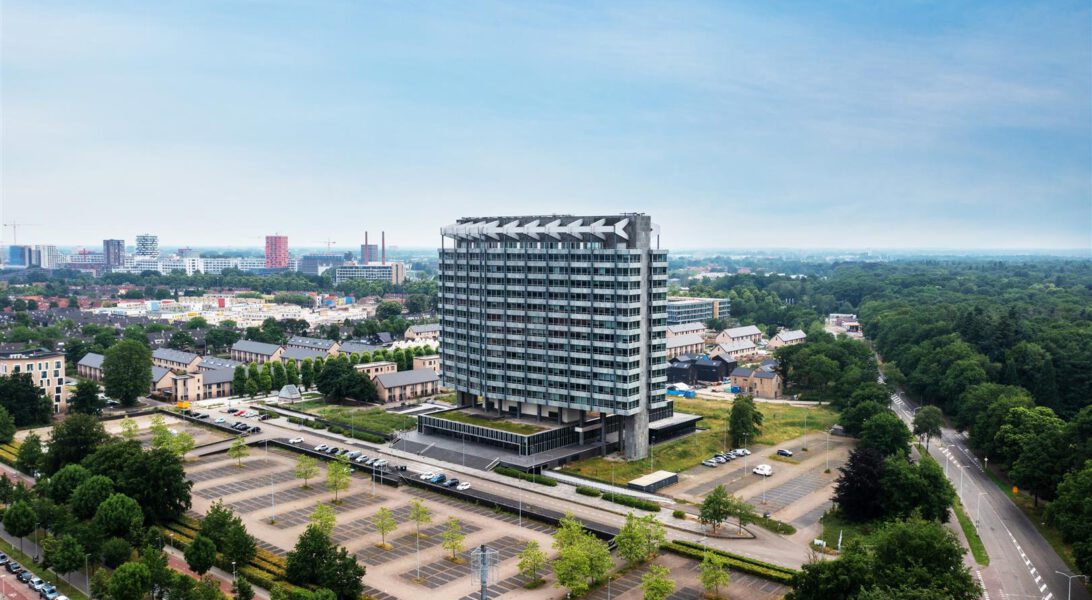
Gateway to the city
The Vredeoord site is located along the old route leading out of the city towards Den Bosch, near the wooded estate De Grote Beek in the northwest of Eindhoven. The 66-metre-high Philips office building (from 1964), designed by the architectural firm Roosenburg–Verhave–Luyt–De Jongh, is the landmark of the site. At the time, this national monument stood at the edge of the built-up area and marked the entrance to the city.
The expressive headquarters was a technical feat of construction, with a crown of steel frames from which the floors are suspended by rods. For decades, the impressive architecture functioned as a status symbol of Philips, the company that played an (inter)national role in the post-war economy from its base in Eindhoven.
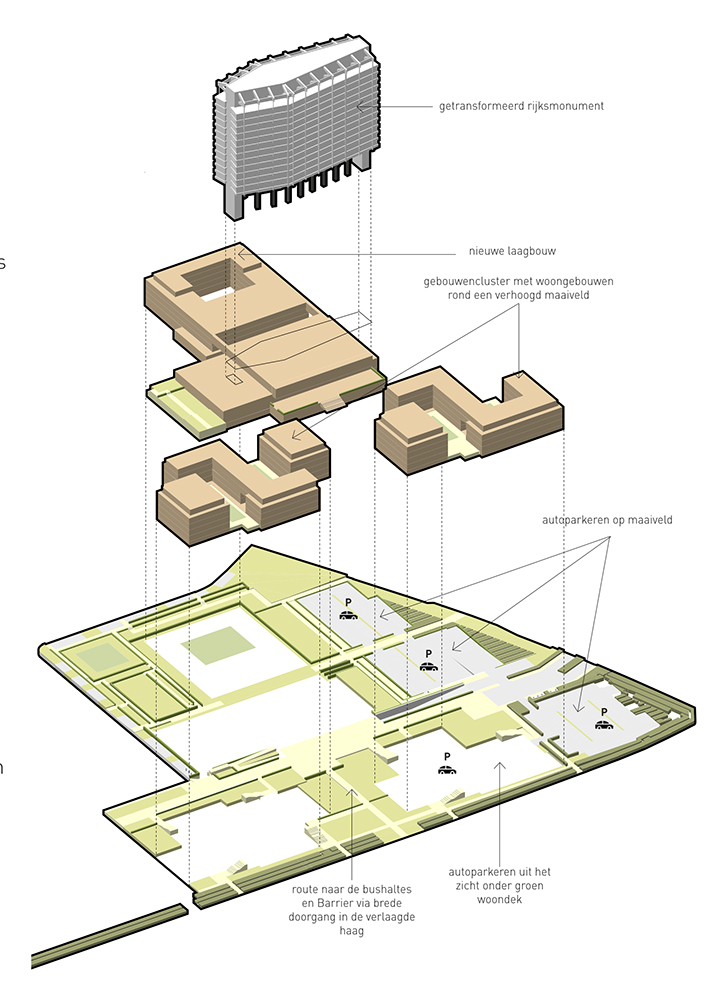
The national monument and the new low-rise buildings with newly designed gardens.
Heritage strategy
The defining characteristics of the monumental headquarters and the original layout of the site have been identified and guide the new plans. Based on a formulated heritage strategy, the most important cultural-historical values have been taken as key principles for transforming the office campus into a residential neighbourhood.
The protected high-rise building will be renovated and repurposed as apartments. The rectangular low-rise structures next to and beneath the tower are no longer original and will be removed. In the new low-rise buildings, the larger mass and volumetric composition of the original tower base will be retained, allowing the tall, kinked tower to once again appear to float above the ground level and restoring the interplay between the high-rise and low-rise elements.
The classical design of the surrounding site -with sightlines towards the solitary tower and a varied green landscape featuring slopes and stairways- forms the basis for the renewed design of the outdoor space. The route architecturale, a walk that led visitors via embankments, broad staircases and a forecourt to the main entrance of the office and was intended to impress them, will be restored as much as possible in the new landscape design.
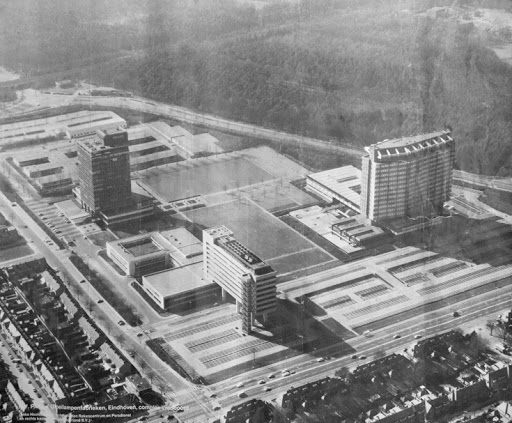
Photo of the original office campus
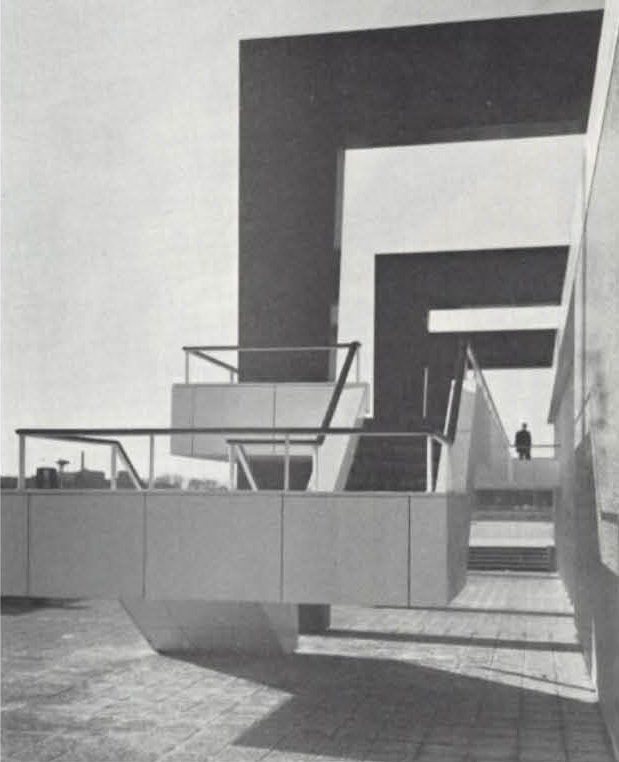
Fragment of the ‘promenade architecturale’
New low-rise buildings
FAAM Architects is responsible for the transformation of the office tower and the design of the new low-rise buildings. The new complex will consist of approximately 550 residential units. The articulation, materialisation, and architectural expression of the original office base—which consisted of several building volumes—serve as inspiration for the design. The new low-rise development is conceived as a courtyard building surrounded by green strips, hedges along level changes, and clusters of trees.
Within the courtyard building are apartments with shared laundry facilities and a communal living room, as well as small-scale neighbourhood amenities such as a daycare centre, supermarket, and fitness centre. Along the Vredeoord route, parking areas are located and framed by greenery.
Living along the Boschdijk
Along the Boschdijk used to lie Philips’ elongated parking lot, screened from the road by a triple hedge. With the construction of a row of robust residential buildings and an open square, the new neighbourhood will gain a recognisable address along the Boschdijk.
The residential buildings, comprising approximately 210 units, are designed by Paul de Ruiter Architects. The strip of different volumes is conceived as an ensemble with a single architectural signature and a clear identity. Parking facilities are accommodated in the plinths, partly covered with green decks. On top of these sit all-sided building blocks and meandering gallery-access blocks of four or five storeys. The building height aligns with the neighbouring Medical Centre and forms a transition between the older low-rise, ground-based houses in the surrounding area and the much taller Philips tower.
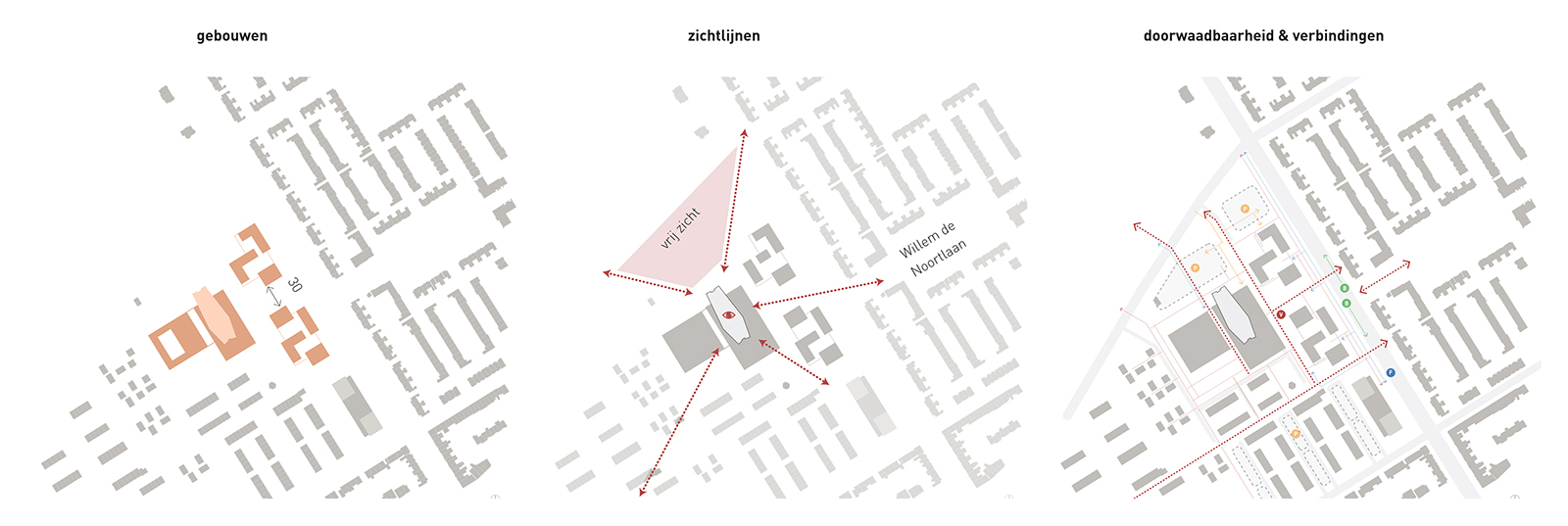
Between the residential buildings lies a wide green square offering open views towards the former Philips office building, the visual highlight of the neighbourhood. The three rows of hedges along the Boschdijk will be partially removed to enhance the openness of this entrance square. The square strengthens the visual connection between the new residential neighbourhood Vredeoord, the Boschdijk, and the low-rise Barrier district on the opposite side.
Car-light residential park
Vredeoord is a car-light residential park of approximately 5 hectares where greenery and pedestrians take centre stage. There are no through-routes for cars; instead, short access roads at the edges provide parking spaces.
An orthogonal network of paths and shortcuts for cyclists and pedestrians creates a highly permeable layout. From the Boschdijk, the Loper extends into the neighbourhood, while on either side of the office tower lie the ‘boulevard’ and the ‘campus street’. These are wide walking and cycling promenades that connect the area with its surroundings and with the wooded estate De Grote Beek. The promenades are lined with hedges and trees—partly existing—and lead through a varied garden landscape with stairways, terraces, and platforms. It is a contemporary interpretation of the former Philips office gardens, of which the vegetable garden, hedges, and groups of trees have been preserved.
Innovation
Just as Philips once realised an innovative structural system with suspended floors for its headquarters, the Vredeoord residential neighbourhood aims to apply innovative construction methods such as CLT and timber construction. The landscape design is also forward-looking, creating a green and climate-adaptive residential environment.
The green structure of hedges and large trees along the edges of the project area is original. Across the rest of the site, however, a substantial amount of greenery is added—far more than required by standard regulations. Another innovative feature is the rainwater drainage system, which channels water through a network of drainage gutters towards the lower-lying estate De Grote Beek. These gutters remain visible in the paving. Near the Dreef, an unpaved depression functions as an above-ground water storage basin during extreme weather conditions.
In the future, the design of the De Grote Beek estate will once again live up to its name, as the stream the Grote Beek will return above ground, just as it once flowed in the past.